Direct, organic and referral traffic are the three channels most website owners see first in Google Analytics, and they answer one question: where did this visit come from? Direct traffic means GA4 has no source for the visit, organic traffic comes from unpaid search results and referral traffic from links on other sites. This guide explains how GA4 assigns every visit to a channel, why direct traffic is usually too high and what to check each month.
What are traffic sources?
A traffic source is the origin of a visit to your website. Google Analytics 4 describes it with three layers:
- Source: where the visit came from, for example
google,facebook.comornewsletter. - Medium: the type of traffic, for example
organic,cpc,referraloremail. - Channel: a group of source and medium pairs with a readable name, such as Organic Search or Direct.
Source and medium come from the referrer (the page the visitor was on before) or from UTM parameters in the link. The channel is calculated from them with rules that Google defines. Most reports start with channels because seven or eight lines are easier to read than hundreds of sources.
How GA4 groups traffic: the default channel group
The default channel group is the set of rules GA4 uses to put each session into a channel. Google publishes the definitions of every default channel, and you cannot edit them, although you can build a custom channel group next to them.
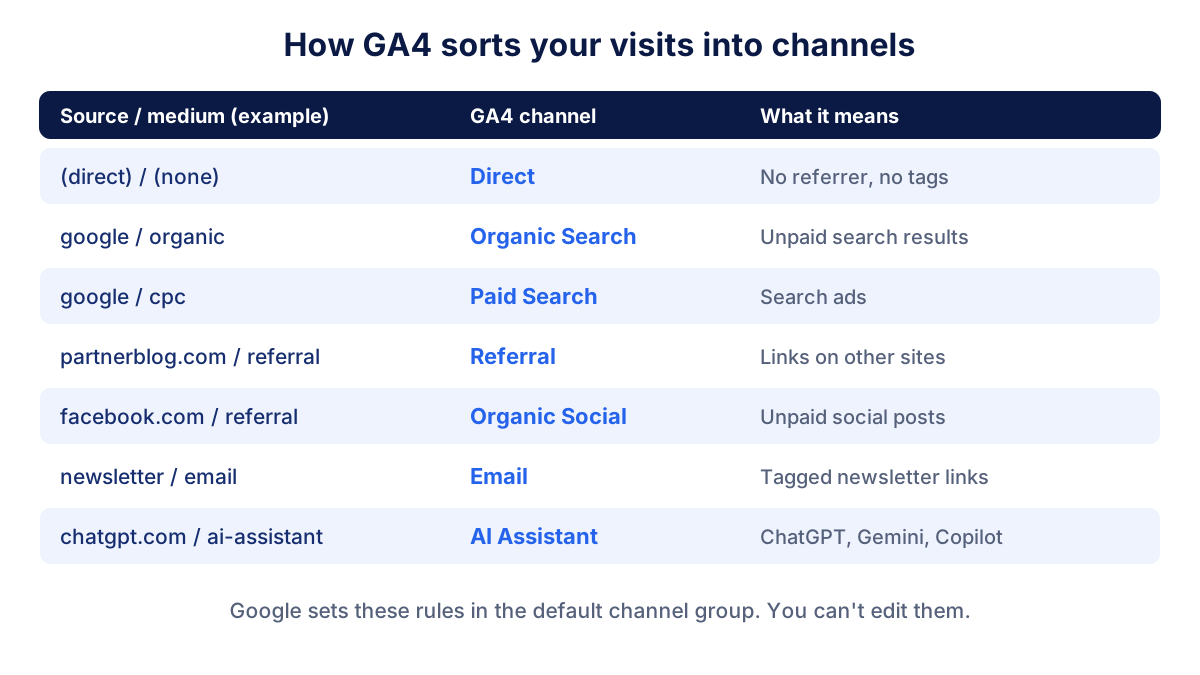
| Channel | Rule in plain words |
|---|---|
| Direct | Source is (direct) and medium is (none) or (not set) |
| Organic Search | Source is a known search engine, or medium is organic |
| Paid Search | A search engine with a paid medium such as cpc, or Google Ads search campaigns |
| Referral | Medium is referral, app or link |
| Organic Social | Source is a known social network, or medium is social |
| Paid Social | A social network with a paid medium, or Google Ads social campaigns |
| Source or medium is email | |
| AI Assistant | Medium is ai-assistant, or the referrer is on Google's list of AI assistants |
| Unassigned | Nothing above matched |
Other channels exist (Display, Organic Video, Organic Shopping, Affiliates, Cross-network and more), but for most small business websites the lines above cover nearly all visits.
What is direct traffic and why is it often inflated?
Direct traffic is the channel for visits with no known source. Google describes it as users arriving via a saved link or by typing your URL. That is the genuine part: loyal customers, staff, people who saw your name on a van or a business card.
The other part is visits that lost their source. When a link carries no UTM tags and the browser sends no referrer, GA4 has nothing to go on and files the session under Direct.
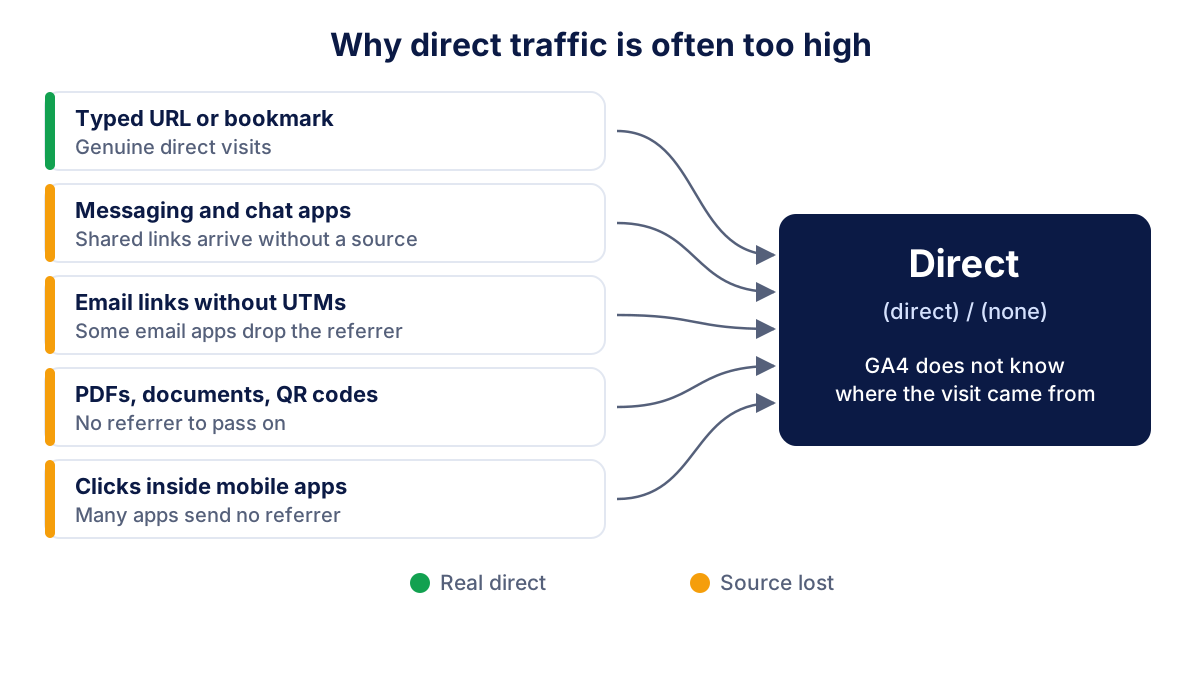
Typical causes of inflated direct traffic:
- Links shared in messaging and chat apps.
- Newsletter links without UTM parameters, opened in email apps that do not pass a referrer.
- Links in PDFs, presentations and offers, and QR codes on printed material.
- Clicks inside mobile apps, which often send no referrer.
- Technical issues, such as redirects that drop the referrer or pages missing the tracking tag.
A direct share that suddenly jumps is rarely a sign that more people typed your address. It usually means a campaign went out without tags, or that something broke in the tracking.
What is organic traffic?
Organic traffic, in everyday use, means visits from unpaid search results. In GA4 that is the Organic Search channel: the source is a known search engine (Google, Bing and others) or the medium is organic. Google states that clicks from its AI Overviews and AI Mode are counted here as well, not in the AI Assistant channel.
Organic Social is the unpaid counterpart on social networks: a post, a profile link, a share. It is a separate channel, so "organic traffic" in a conversation may mean either. Be precise in your own notes.
Organic traffic is the channel you build rather than buy. It grows with useful pages, a well kept site and a correct presence in Search Console. If you want to compare it with Bing, our guide to Bing Webmaster Tools shows where to find those numbers.
What is referral traffic?
Referral traffic is a visit from a normal link on another website or app: a supplier's partner page, a trade directory, a local news article, a blog that mentioned you. GA4 counts it as Referral when the medium is referral, app or link and no other rule applies first.
Referral is often small but valuable, because people who arrive from a recommendation tend to be well informed. Look at the list of referring sources at least once a quarter: it tells you who links to you and which mentions bring real visits.
Two common distortions show up here. Payment providers can appear as referrers when customers return from checkout, which takes credit away from the real channel; GA4 lets you list unwanted referrals in the data stream's tag settings. And your own domain listed as a referrer usually points to a page without the tracking tag.
AI assistants: ChatGPT, Perplexity and the AI Assistant channel
Visits from AI assistants are a new and growing group of referrals. When someone clicks a link inside an answer, the browser usually passes the assistant's domain as referrer.
GA4 now has a dedicated AI Assistant channel. Google's help page names ChatGPT, Gemini, Deepseek, Copilot and Grok as examples and sets the medium to ai-assistant when the referrer is on its list. An assistant that is not on the list, which may be the case for Perplexity or smaller tools, can still appear as Referral with its domain as the source. Clicks from desktop or mobile apps that send no referrer end up in Direct.
So when you look for AI visits, check three places: the AI Assistant channel, the Referral sources (look for domains such as perplexity.ai), and any odd rise in Direct. Volumes are still small for most businesses, but these visitors often arrive with a specific question already answered. Our article on generative engine optimization explains how to be cited in those answers.
Paid vs organic: how GA4 tells them apart
GA4 does not know whether you paid for a click. It reads the medium. Google Ads with auto-tagging is recognised automatically, and its search campaigns land in Paid Search. Other platforms need you to tell GA4, through UTM parameters, that the traffic is paid.
This is why untagged Meta ads are a classic problem: a click from a Facebook or Instagram ad without UTMs arrives with a social source and a referral medium, so GA4 counts it as Organic Social. Your ads look free and your organic social looks brilliant. Tag paid social links with a paid medium such as paid_social or cpc and they move to Paid Social.
How UTM parameters fix attribution
UTM parameters are tags you add to a link so GA4 knows exactly where the click came from. Google's URL builder guide says to always use utm_source, utm_medium and utm_campaign:
yoursite.com/offer?utm_source=newsletter&utm_medium=email&utm_campaign=october_offer
Tag every link you control: newsletters, social posts, ads outside Google Ads, QR codes, PDFs, partner links. Use lowercase and a fixed list of mediums that match GA4's rules (email, social, cpc, referral), otherwise visits fall into Unassigned. Our guide to UTM parameters includes a free link builder.
What to look at every month
Traffic sources are worth a short monthly check. In GA4 the Traffic acquisition report, under Reports and Acquisition, shows sessions and key events per channel; our GA4 guide shows where to find it.
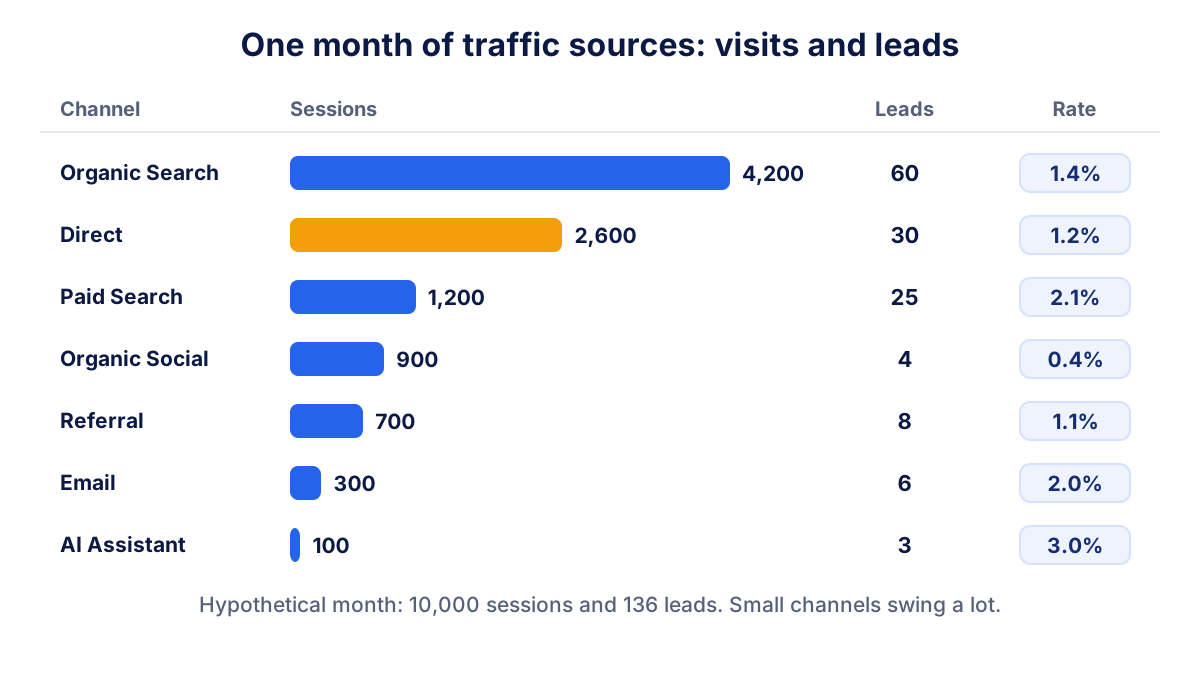
Each month, ask five questions:
- Which channels grew or fell compared with last month and the same month last year?
- Which channels bring results, not just visits? Compare leads or sales per channel.
- Did Direct move? A jump usually means untagged campaigns or a tracking problem.
- Is Unassigned above a few percent? Fix the UTM values that cause it.
- Who sends referrals, including AI assistants, and is that growing?
In the hypothetical month above, Organic Search brings 60 of 136 leads, while Paid Search converts at 2.1% and Organic Social at 0.4%. That is the kind of comparison that decides where next month's time and budget go.
If opening GA4 every month is the step that never happens, Klyrax shows your channels next to Search Console and your ad accounts in one summary, and on the 1st of each month writes a plain-language report on which sources moved and what to do about it. It can also show how often your business appears in ChatGPT, Gemini, Perplexity and Claude, so the AI channel does not stay a blind spot.
Frequently asked questions
What is direct traffic?
Direct traffic is the GA4 channel for sessions whose source is (direct) and medium is (none). Google describes it as users arriving via a saved link or by entering your URL. In practice it also collects any visit whose origin was lost, such as clicks from chat apps, some email apps, PDFs or mobile apps that send no referrer and carry no UTM parameters.
What is referral traffic?
Referral traffic is a visit that arrives through a normal, non-ad link on another website or app, such as a blog, a news site, a directory or a partner page. In GA4 the Referral channel covers sessions whose medium is referral, app or link. Search engines, social networks and recognised AI assistants have their own channels, so they are not counted as referral.
What is organic traffic?
Organic traffic usually means visits from unpaid search results on Google, Bing and other search engines. GA4 calls this channel Organic Search, and according to Google it includes clicks from AI Overviews and AI Mode. Unpaid visits from social networks have a separate channel, Organic Social. Organic traffic grows with SEO work, not with ad spend.
Why is my direct traffic so high?
Direct traffic is high when many visits lose their source on the way. Common causes are untagged links in newsletters, links shared in messaging apps, QR codes and PDFs without UTM parameters, clicks inside mobile apps, and tracking problems such as redirects that drop the referrer. Tag every link you control with UTM parameters and direct will shrink to genuine typed and bookmarked visits.
Do ChatGPT and Perplexity visits show up in GA4?
Yes, when the visitor clicks a link in the answer. GA4 has an AI Assistant channel for traffic from assistants on Google's list, and the help page names ChatGPT, Gemini, Deepseek, Copilot and Grok. An assistant that is not recognised can still appear as Referral with its domain as source, and clicks from apps that send no referrer land in Direct.
See how your marketing is really doing
Klyrax connects GA4, Search Console, Google Ads, Meta Ads, your Google reviews and more in read-only mode, shows the numbers that matter for your business and writes you a plain-language report every month.
Request info