Fake Google reviews are reviews that do not describe a real experience with your business: paid ones, reviews written by staff or friends, and reviews posted in exchange for a discount. Buying them looks like a quick fix for a weak rating, but Google's systems are built to find them, the reviews get removed and the profile itself can be restricted, with a warning that customers can see.
This guide is for owners and managers who are tempted, or who have been offered a "reputation package". It covers what Google's policy forbids, how detection works, what happens to the profile, how customers spot bought reviews, what to do if someone posts fake reviews about you and a practical way to get real ones.
What counts as a fake Google review?
Google groups fake reviews under fake engagement in its prohibited and restricted content policy for Maps. The principle is one sentence: a review must reflect a genuine experience at the place. Anything else can be removed.
In practice, the policy covers more than a stranger paid to write five stars:
- Reviews or ratings paid for, in money or in kind.
- Reviews posted from several accounts by one person, or at the request of one person.
- Reviews by people with a conflict of interest: you, your employees, former employees, family, suppliers or a competitor.
- Reviews given in exchange for an incentive: a discount, a free coffee, a gift card, an entry in a prize draw.
- Asking only happy customers for reviews (often called review gating) or discouraging negative ones.
- Negative reviews posted on a competitor's profile to hurt it.
The incentive rule surprises many owners. A sign saying "Leave us five stars and get 10% off your next visit" breaks the policy even if every customer who uses it is sincere. The guide on responding to Google reviews and getting more covers what you may and may not say when you ask.
How Google detects fake reviews
Google does not publish its detection rules, for obvious reasons. What it does say, in its Maps posts on blog.google, is that machine learning models check contributions first, looking at the review text, the history of the account and unusual activity on the place. Human analysts handle what the models flag and audit the results.
The scale is large. In a post from April 2026, Google said it blocked or removed over 292 million policy-violating reviews in 2025. Most are stopped before anyone sees them. Google also says it can now revisit reviews months after they were posted, when new abuse patterns are found.
That last point is the one that matters for anyone thinking of buying Google reviews. A package that "sticks" for three weeks proves nothing. The reviews were posted by accounts that are, by design, part of a network, and when Google identifies the network, every review it touched is at risk, including yours.
The patterns that typically stand out are the same ones a careful reader notices:
- A burst of five-star reviews in a few days after months of silence.
- Reviewer accounts with one or two reviews, no photos, or reviews of businesses in many distant cities on the same day.
- Short, generic texts with similar wording.
- A rating that moves much faster than the business's normal flow of customers would allow.
What happens if you buy Google reviews?
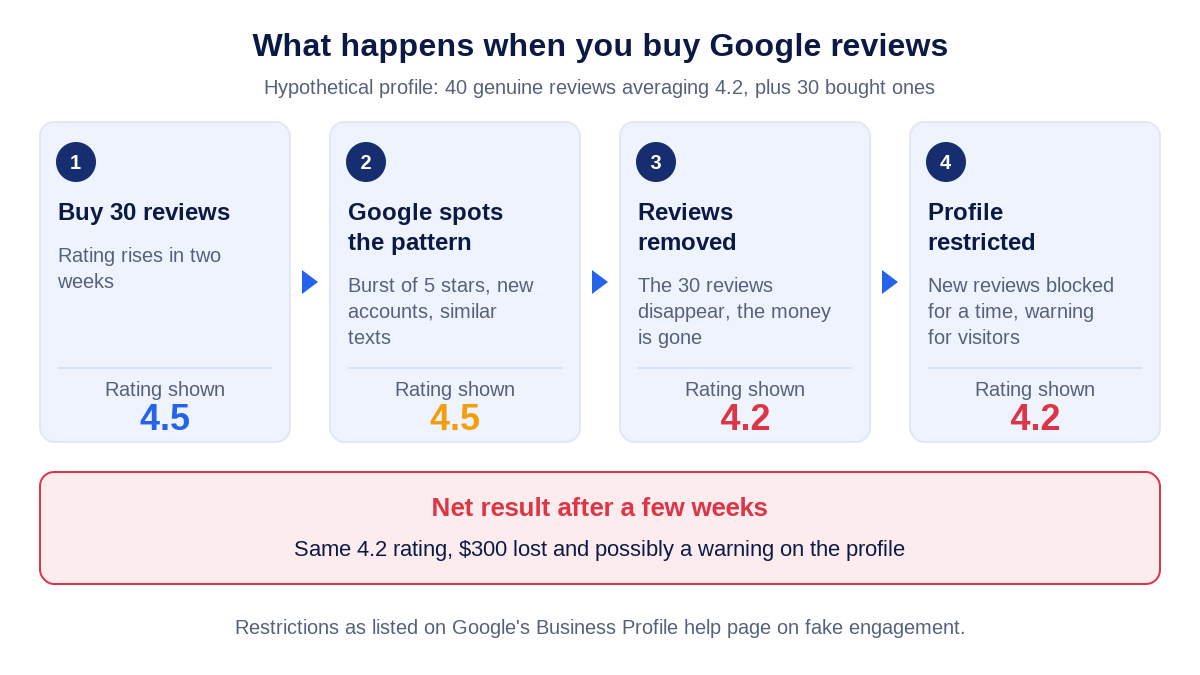
The first consequence is the obvious one: Google removes the reviews and your money is gone. The second is less known. Google's help page on Business Profile restrictions for fake engagement says that a profile that violates the policy can be restricted for a set period. The restrictions it lists are:
- The profile cannot receive new reviews or ratings for a while.
- Existing reviews and ratings may be unpublished for a while, genuine ones included.
- Visitors may see a warning on the profile saying that fake reviews were removed.
Google sends the owner an email when a restriction is planned, and you can appeal through the link on that page. Google then reviews the profile again, with any context you add, and tells you whether the restriction is lifted. The accounts that posted the fake reviews can also be suspended or terminated under the contribution policy.
Here is a hypothetical example. Your profile has 40 genuine reviews with an average of 4.2. You buy 30 five-star reviews for, say, $300.
New average = (40 × 4.2 + 30 × 5) ÷ 70 = (168 + 150) ÷ 70 = 4.54
For a few weeks the profile shows 4.5. Then Google removes the 30 reviews: the average goes back to 4.2, the $300 is lost, and in the worst case new reviews are blocked and a warning explains why. The rating you wanted to fix is unchanged, and now customers have a reason to distrust it.
Bought reviews vs real reviews: the numbers
Compare the two routes over three months, using the same profile. For the real route, assume 100 customers a month, asked once each, and that 10% of them leave a review with an average of 4.6. All numbers are hypothetical.
| 30 bought reviews | 30 real reviews | |
|---|---|---|
| Cost | $300, paid upfront | Your time, a link and a message |
| Time to get 30 reviews | 1 to 2 weeks | About 3 months |
| Rating after 30 reviews | 4.5, temporarily | 4.4, and it stays |
| What happens next | Removal, possible restriction and warning | Reviews stay and keep coming |
| What readers see | A burst from thin accounts | Details about real visits, your replies |
The real route ends with a slightly lower number, (40 × 4.2 + 30 × 4.6) ÷ 70 = 4.37, shown as 4.4. But that 4.4 is still there in a year, it keeps growing every month and nobody can take it away.
How customers and competitors spot fake Google reviews
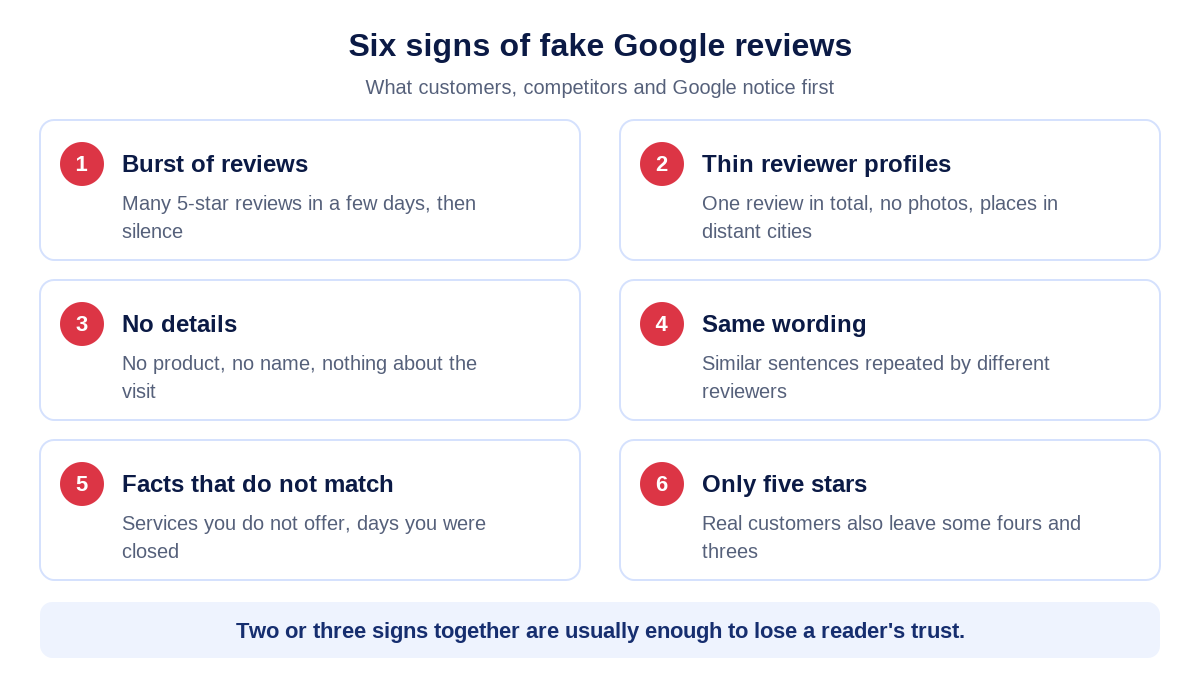
Google is not the only one looking. Customers read reviews before calling you, and a competitor who sees your rating jump will look closely. Most people need only a minute to notice the signs:
- Timing. Twenty reviews in one week on a profile that usually gets two a month.
- Thin profiles. Tapping a reviewer's name shows their other reviews. One review in total, or reviews of a dentist, a hotel and a car dealer in three countries on the same day, is a red flag.
- No details. "Great service, highly recommended" with no product, no name, no detail of the visit.
- Same voice. Similar sentences, the same unusual words, the same mistakes across different reviewers.
- Wrong facts. Praise for a service you do not offer, or a visit on a day you were closed.
- Only five stars. A real flow of customers produces some fours and the occasional three.
Competitors can report reviews on your profile too. Anyone can flag a review in Google Maps. A rating built on bought reviews is a rating someone else can bring down with one well-chosen report.
What to do if someone posts fake reviews about you
The opposite case is common: one-star reviews from people who were never customers, sometimes in a sudden wave. Here is the practical order.
- Check before you report. Compare names and dates with your bookings or invoices. Some "fake" reviews are real customers using a nickname.
- Report each review from your Business Profile with the matching reason: fake engagement for a review not based on a visit, conflict of interest for a competitor or former employee. The steps and the appeal are explained in the guide on how to remove a Google review.
- Reply in public, briefly and calmly: "We can't find any visit under this name. Please contact us so we can look into it." Readers see the reply even before Google decides.
- Do not answer with reviews of your own. Asking friends to post five stars to compensate creates a second violation, on your side.
- Do not pay anyone who offers to remove the reviews for money. Google says it has upgraded its systems against attempts to demand payment for removing fake one-star reviews, and it has a help page on how to report negative review extortion scams. Keep screenshots of the reviews and the messages.
If the wave is large, Google may pause new reviews on the profile and show a banner explaining why, according to its April 2026 post. That protects you while the reviews are checked.
Already bought reviews? What to do now
If a supplier or an agency has already posted reviews for you, stop the service immediately and do not add more. Owners cannot delete reviews themselves, so you cannot clean the profile alone, but you can make sure nothing new is added.
If Google emails you about a restriction, appeal only with context that is true, for example that an external supplier acted without your knowledge if that is really the case. Then put the effort into real reviews. A profile that receives genuine reviews every month after the restriction ends tells a better story than any appeal.
How to get real Google reviews instead
The only method that works over time is asking every customer, in the same way, at the right moment:
- Get your review link from your Business Profile and turn it into a QR code. The guide to the Google review link shows where to find it.
- Ask everyone, not only the customers you think are happy. Same message, same link.
- Ask soon after the purchase or visit, by email, text or a card at the counter.
- Make it easy: one link, one sentence, no form to fill in first.
- Reply to every review, positive and negative, within a few days.
- Offer nothing in return. No discount, no draw, no gift.
Three months of this routine usually beats any package you could buy, and it also gives you something bought reviews never do: honest feedback about what to fix.
What to check every month
Once a month, look at four numbers on your profile: new reviews, average rating of the new reviews, unanswered reviews and the overall rating. A sudden spike in any direction deserves a look, whether it is a burst of five stars you did not ask for or a wave of one-star reviews.
Klyrax reads the public data of your Google profile through its Google reviews and Maps channel (rating, new reviews, unanswered reviews and Maps positions for the keywords you choose) next to your website and ads data. An unusual jump in reviews stands out in the trend, and the monthly written report points it out in plain language. For the wider picture, see the guide to ranking on Google Maps.
Frequently asked questions
Can Google tell if you buy reviews?
Often, yes. Google says its systems look at the review text, the history of the account that posted it and unusual activity on the place, and that human analysts check what the models flag. A burst of five-star reviews from new or distant accounts is exactly the kind of pattern that stands out. Google can also re-check reviews months after they were posted.
What happens if you get caught buying Google reviews?
Google removes the fake reviews. According to its Business Profile help page, it can also restrict the profile for a set period: new reviews may be blocked, existing reviews may be unpublished, and visitors may see a warning that fake reviews were removed. The owner receives an email before a restriction and can appeal. The accounts that posted the reviews can be suspended.
Is it allowed to offer a discount for a Google review?
No. Google's policy forbids offering payment, discounts, free products or services in exchange for a review, for changing a review or for removing a negative one. This applies even if the customer is genuinely happy and would have written the same review anyway. Asking for a review without offering anything is allowed and encouraged.
How do I report fake Google reviews on my profile?
Open your Business Profile, select Read reviews, use the report option next to the review and choose the reason that fits, for example fake engagement or conflict of interest. You can follow the report in Google's Reviews Management Tool and appeal once if Google keeps the review. Reply calmly in public while you wait, because the decision can take several days.
How many Google reviews do I need?
There is no official number. What helps customers decide is a steady flow of recent, detailed reviews and visible replies from you. A profile with 60 reviews spread over two years usually looks more credible than one with 60 reviews from the same fortnight. Aim for a regular rhythm, for example a few new reviews every month, rather than a target total.
See how your marketing is really doing
Klyrax connects GA4, Search Console, Google Ads, Meta Ads, your Google reviews and more in read-only mode, shows the numbers that matter for your business and writes you a plain-language report every month.
Request info