
Customer acquisition cost (CAC) tells you how much you spend, on average, to win one new customer. To calculate it, divide your marketing and sales costs by the number of new customers in the same period: $4,000 of costs and 20 new customers give a CAC of $200. This guide covers the formula, cost per lead, CAC payback and lifetime value, two worked examples and a simple way to track the number every month.
What is customer acquisition cost (CAC)?
Customer acquisition cost is the total cost of marketing and sales in a period divided by the number of new customers won in that period. It answers a blunt question: what does a new customer cost you?
The number matters because every other marketing metric sits upstream of it. Clicks, impressions and even leads can rise while the cost of an actual customer goes up too. CAC connects your marketing budget to the one result that pays the bills, and it lets you compare channels that look nothing alike: a Google Ads campaign, a trade fair, a LinkedIn budget, a newsletter.
Cost per lead (CPL) is its close relative. Customer acquisition cost divides costs by customers, cost per lead divides them by enquiries. A business that generates leads needs both, because the step from lead to customer is where many budgets quietly leak.
How to calculate customer acquisition cost: the formulas
The customer acquisition cost formula is:
CAC = (marketing costs + sales costs) ÷ new customers
Two related formulas use the same cost total:
Cost per lead = (marketing costs + sales costs) ÷ leadsClose rate = new customers ÷ leads × 100
Use the same period for all of them, usually a month or a quarter. Count only new customers, not repeat buyers or renewals. If you only include ad spend in the numerator, say so clearly and call the result "paid CAC", because it will be lower than the full figure.
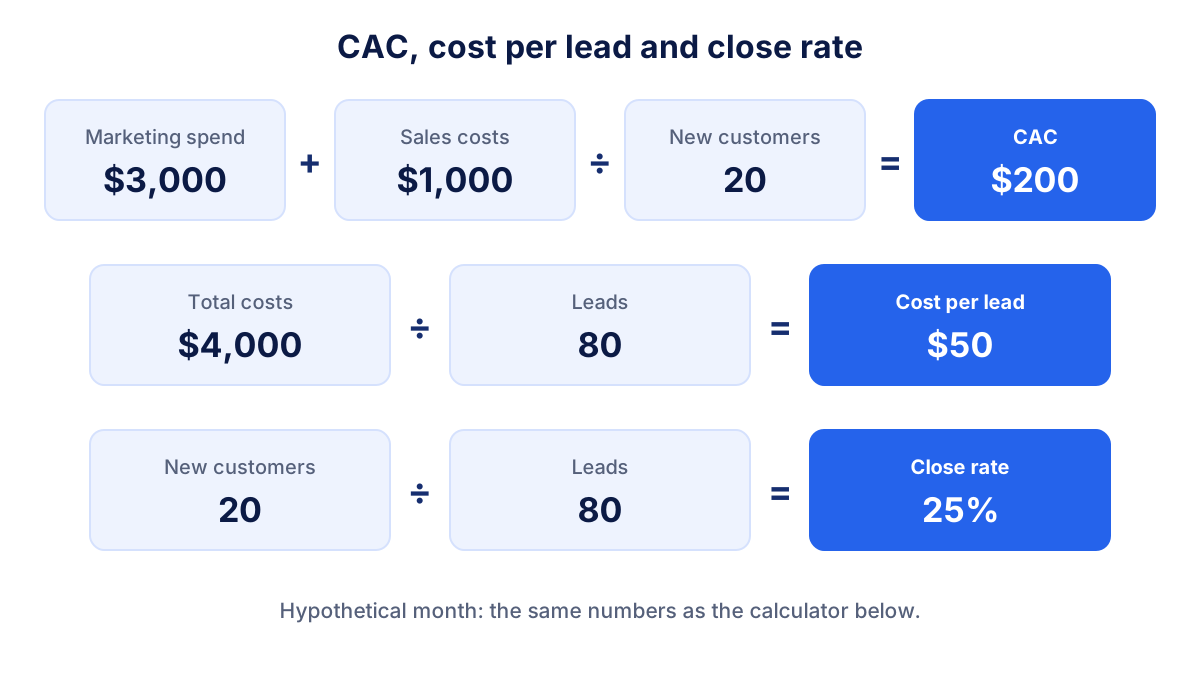
Try it with your own numbers. Leads are optional: add them to see your cost per lead and how many leads became customers.
Customer acquisition cost calculator
Use the same period for costs, leads and customers: the result updates as you type.
What to include in your acquisition costs
The most common reason CAC looks better than it is: half the costs are missing. As a rule, include anything you would stop paying if you stopped looking for new customers.
| Include | Usually leave out |
|---|---|
| Ad spend (Google Ads, Meta Ads, LinkedIn, Microsoft Ads) | Costs of serving existing customers |
| Agency or freelancer fees for campaigns, SEO and content | Product development |
| Marketing and sales tools (CRM, email, landing page builder) | General office costs |
| Share of salaries spent on marketing and new business | Account management and support |
| Trade fairs, events, sponsorships, printed material | Discounts given to existing customers |
| Discounts or free trials used to win first orders | Shipping and cost of goods (they belong in margin) |
You do not need accounting precision. If a salesperson spends roughly half their time on new business, count half their cost. Pick a method, write it down and keep it the same every month, so the trend is honest even if the absolute number is approximate.
CAC vs cost per lead vs CPA: what is the difference?
These three numbers share a numerator but count different things, and ad platforms add a fourth, cost per click.
| Metric | Formula | Answers |
|---|---|---|
| CPC (cost per click) | ad spend ÷ clicks | What does a visit from an ad cost? |
| CPA (cost per action) | ad spend ÷ conversions counted by the platform | What does a conversion cost inside this ad account? |
| Cost per lead | all acquisition costs ÷ leads | What does an enquiry really cost? |
| CAC | all acquisition costs ÷ new customers | What does a paying customer cost? |
CPA is what Google Ads uses when you choose Target CPA bidding: you set the average cost per conversion you want, and the system bids for you. It only knows about ad spend and the conversions it tracked. That makes it useful for running campaigns and misleading as a business number.
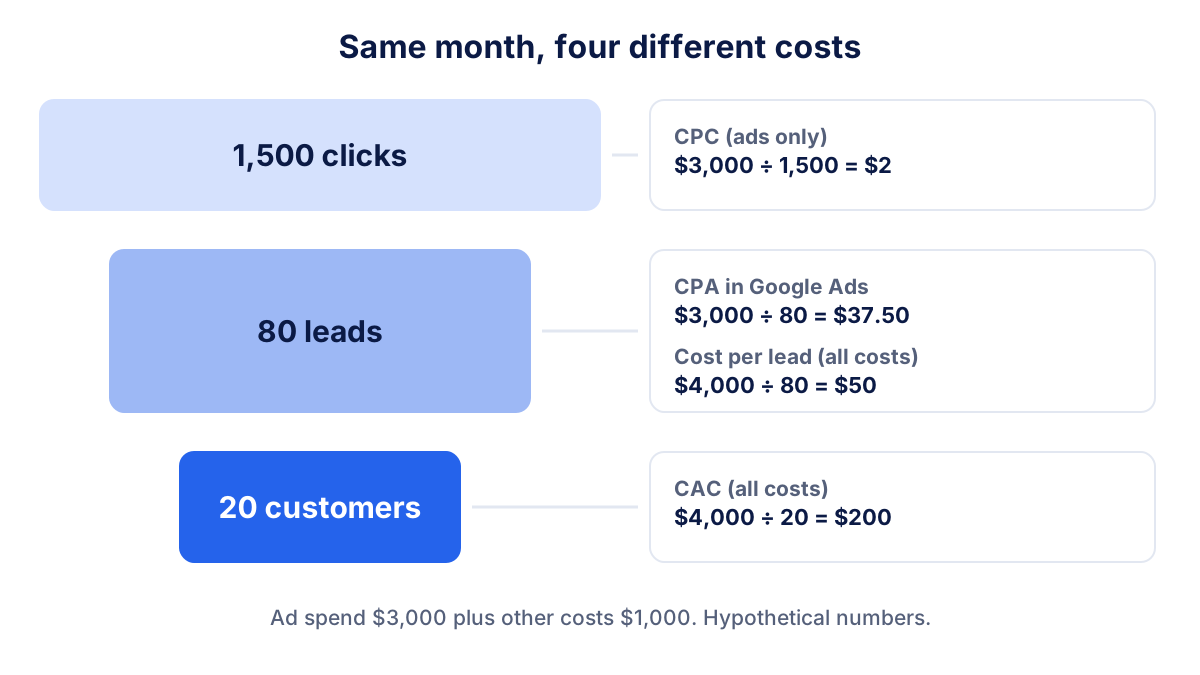
In the example above, the ad account reports a CPA of $37.50. Add the other $1,000 of costs and the real cost per lead is $50. Only one lead in four becomes a customer, so the customer acquisition cost is $200. Same month, same campaigns, four very different numbers.
CAC payback and customer lifetime value, in simple terms
A CAC of $200 is neither good nor bad on its own. It depends on what a customer earns you, and two simple ideas help.
Customer lifetime value (CLV or LTV) is the gross margin a customer brings during the whole relationship. Use margin, not revenue: if you sell a $100 monthly service with a 60% gross margin and customers stay about 24 months, lifetime value is $60 × 24 = $1,440.
CAC payback is how many months of margin it takes to recover the acquisition cost:
CAC payback (months) = CAC ÷ monthly gross margin per customer
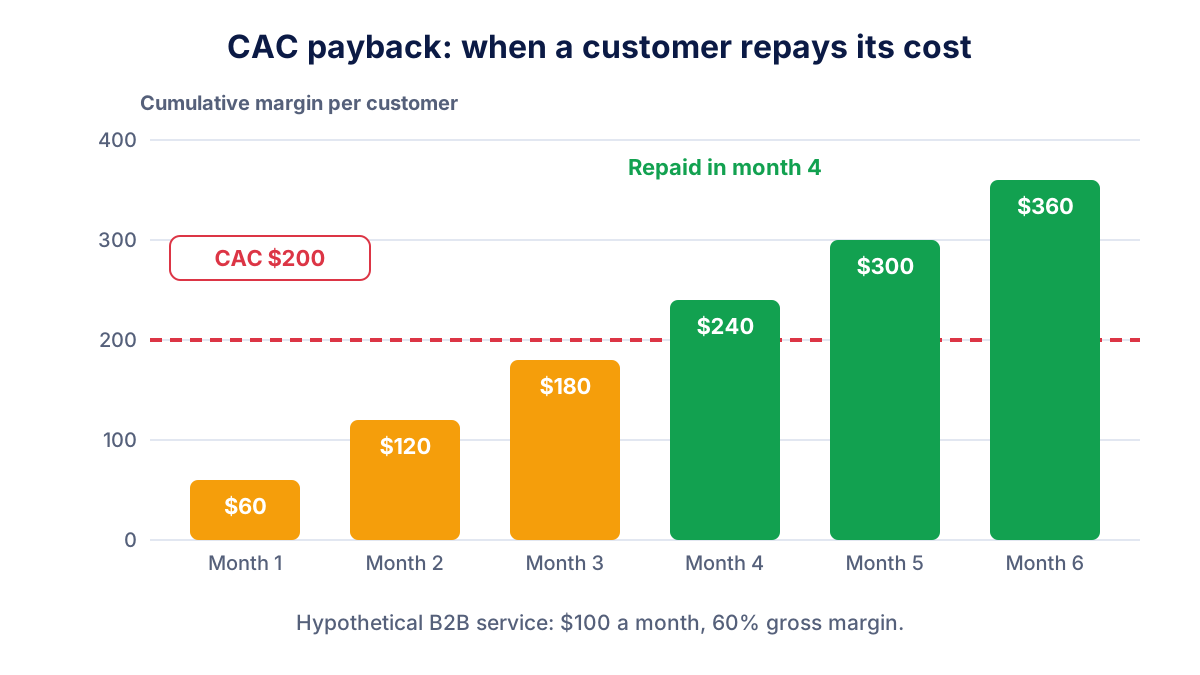
With a $200 CAC and $60 of margin a month, payback is about 3.3 months. Compare lifetime value with CAC too: $1,440 against $200 is a ratio of about 7 to 1. In software circles you will often hear 3 to 1 quoted as a healthy ratio. Treat it as a talking point, not a target: what matters is that customers pay back their cost well before they leave, and that you have the cash to wait.
Worked examples: a small B2B company and an online shop
A B2B service business
A company sells an IT maintenance contract at $100 a month. In one month it spends $3,000 on Google Ads and LinkedIn Ads, plus about $1,000 of a salesperson's time and its CRM.
- Total acquisition costs: $4,000
- Leads from the website: 80, so cost per lead = $50
- New contracts signed: 20, so close rate = 25%
- CAC = $4,000 ÷ 20 = $200, payback ≈ 3.3 months
This business is in good shape and could spend more. The quickest win is probably on the sales side: lifting the close rate from 25% to 30% brings 24 customers instead of 20 and drops CAC to about $167 without touching the ads. B2B deals often close weeks after the first enquiry, so look at a rolling three months rather than a single month.
An online shop
A shop spends $5,000 on Meta Ads and Google Ads plus $1,000 on an agency and tools. It takes 300 orders in the month, 150 of them from first-time customers. Average order value is $60 and gross margin is 40%, so each order leaves $24.
- Cost per order: $6,000 ÷ 300 = $20
- CAC (new customers only): $6,000 ÷ 150 = $40
- First-order margin: $24, which does not cover the $40
The first order loses money. The shop only profits if the average new customer orders again: with three orders over two years, lifetime margin is $72, against a CAC of $40. Its ROAS may look healthy because returning customers buy through the ads too, which is exactly why CAC on new customers is worth calculating separately.
How to lower your customer acquisition cost
- Measure CAC per channel. Tag every campaign link with UTM parameters so leads and customers can be traced back to Google Ads, Meta, LinkedIn, email or organic search. Cut the channels whose leads rarely buy.
- Raise the conversion rate of your landing pages. More leads from the same traffic lowers both cost per lead and CAC. Our guide to conversion rate covers the usual levers.
- Tighten your Google Ads targeting. Negative keywords, location settings and ad schedules stop paying for clicks that never buy. See what Google Ads really costs for how bids and budgets work.
- Answer leads fast. For B2B, a lead contacted the same day is far easier to close than one called a week later. Close rate is half of the CAC formula.
- Grow the channels you do not pay per click for. Search rankings, Google reviews, referrals from happy customers and a useful newsletter bring customers whose marginal cost keeps falling.
- Increase what customers are worth. Better onboarding, repeat purchase emails and upsells do not lower CAC, but they shorten payback and let you afford a higher one.
How to track CAC and cost per lead every month
A one-off calculation is interesting. A monthly series is useful. Once a month, write down the same six numbers: ad spend, other acquisition costs, leads, new customers, cost per lead and CAC. Add the close rate if you sell to businesses.
Take customers from your CRM, invoicing or shop system, not from the ad platforms: platforms count conversions under their own attribution rules, and two platforms may both claim the same customer. Compare each month with the previous one and with the same month last year, and look at a three-month average to smooth out seasonality and slow deals.
The tedious part is gathering spend and leads from several accounts. Klyrax puts your Google Ads, Meta Ads, LinkedIn Ads and Microsoft Ads spend next to the leads and sales tracked in GA4, in a summary built around your goal, such as lead generation or online shop. On the 1st of each month it also writes a short plain-language report on what changed and up to three things to do. You add the customer count from your CRM, divide, and the CAC trend is done in minutes.
Frequently asked questions
How do you calculate customer acquisition cost?
Add up everything you spent to win customers in a period: ad spend, agency or freelancer fees, marketing tools and the part of sales salaries spent on new business. Divide that total by the number of new customers won in the same period. With $4,000 of costs and 20 new customers, CAC = $4,000 ÷ 20 = $200 per customer.
What is the difference between CAC and cost per lead?
Cost per lead divides your costs by the number of enquiries, sign-ups or form submissions. Customer acquisition cost divides the same costs by the people who actually bought. With $4,000 of costs, 80 leads and 20 customers, the cost per lead is $50 and the CAC is $200. The gap between them is your close rate.
Is CAC the same as CPA?
Not quite. CPA is the cost per action or conversion that ad platforms such as Google Ads report: ad spend divided by the conversions the platform counted, which may be leads, calls or purchases. CAC counts all marketing and sales costs and only new paying customers, usually taken from your CRM or shop. CAC is almost always higher than CPA.
What is a good customer acquisition cost?
There is no universal good CAC, because it only makes sense next to what a customer earns you. Compare CAC with the gross margin from one customer over the time they stay. If a customer brings $1,440 of margin and costs $200 to win, you can afford to spend more. If the first order earns $24 and CAC is $40, you depend on repeat purchases.
What is CAC payback?
CAC payback is the number of months it takes for the gross margin from a new customer to cover what you spent to win them. Divide CAC by the monthly margin per customer. A $200 CAC and $60 of margin a month gives a payback of about 3.3 months, so the customer becomes profitable in month four.
See how your marketing is really doing
Klyrax connects GA4, Search Console, Google Ads, Meta Ads, your Google reviews and more in read-only mode, shows the numbers that matter for your business and writes you a plain-language report every month.
Request info