
The ROI formula is ROI = (gain minus cost) ÷ cost × 100. It tells you how much your marketing brought back for every dollar you put in. The catch for a business owner is the word "gain": calculated on revenue, marketing ROI looks spectacular, calculated on gross profit it tells you whether you actually made money.
This guide shows how to calculate ROI step by step, which version to trust, worked examples for Google Ads, Meta Ads, Microsoft Ads and LinkedIn, the difference with ROAS, the break-even point and why the result is always an estimate.
What is ROI in marketing?
ROI (return on investment) is the gain an investment produced, minus what it cost, expressed as a percentage of the cost. Marketing ROI applies the same idea to a campaign, a channel or your whole marketing budget: how much did you get back for what you spent?
An ROI of 0% means you got your money back and nothing more. An ROI of 50% means every $100 spent came back as $150. A negative ROI means the campaign cost more than it returned.
ROI is one of the few marketing numbers your accountant and your sales team understand in the same way. That is why it belongs among your marketing KPIs, usually once a month.
The ROI formula: how to calculate ROI
ROI = (gain minus cost) ÷ cost × 100
The two inputs need a clear definition before you start:
- Cost is everything you spent to run the marketing: ad spend, agency or freelancer fees, tools, creative work. Decide once what you include and keep it the same every month.
- Gain is what the marketing brought in. You can use revenue or gross profit (revenue minus the cost of the products or services sold). The next section explains why the choice matters so much.
A worked example
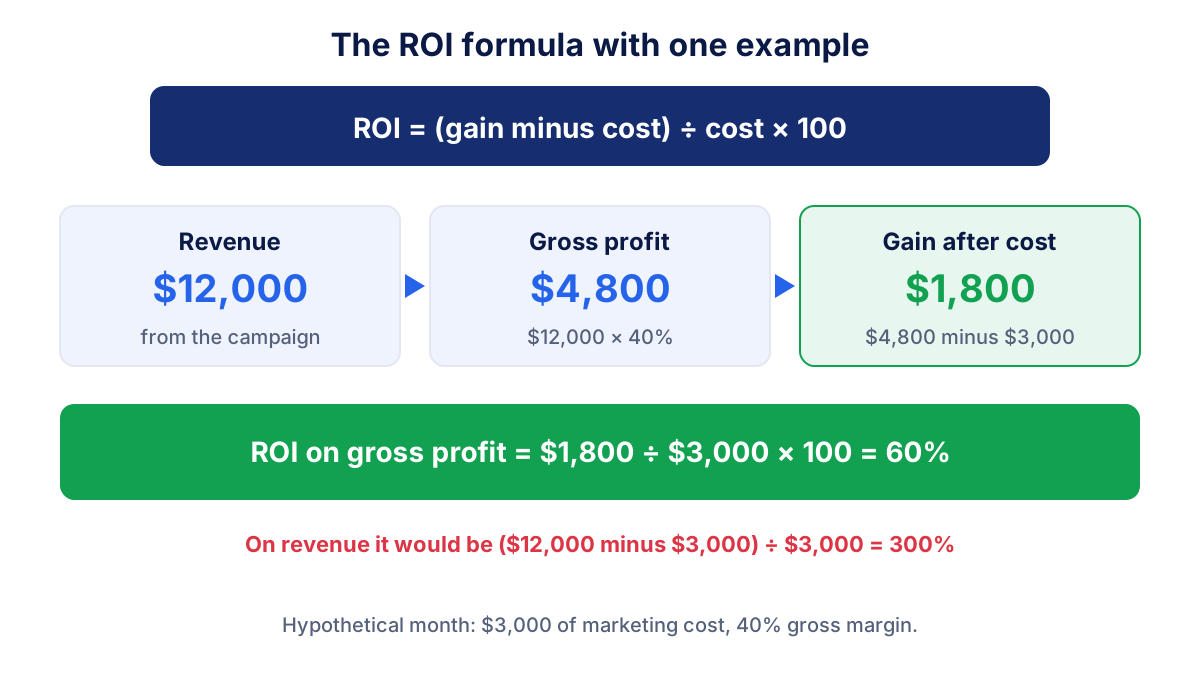
Suppose (hypothetically) you spend $3,000 in one month on ads, and the campaigns bring $12,000 of sales. Your gross margin is 40%.
- Gross profit from those sales: $12,000 × 0.40 = $4,800
- Gain after marketing cost: $4,800 minus $3,000 = $1,800
- ROI on gross profit: $1,800 ÷ $3,000 × 100 = 60%
Try your own numbers. Enter campaign revenue and marketing cost, and add your gross margin to see the honest ROI and what is left after paying for the marketing.
Marketing ROI calculator
Use the same period and the same campaign for revenue and cost: the result updates as you type.
ROI on revenue or on gross profit: which is the honest one?
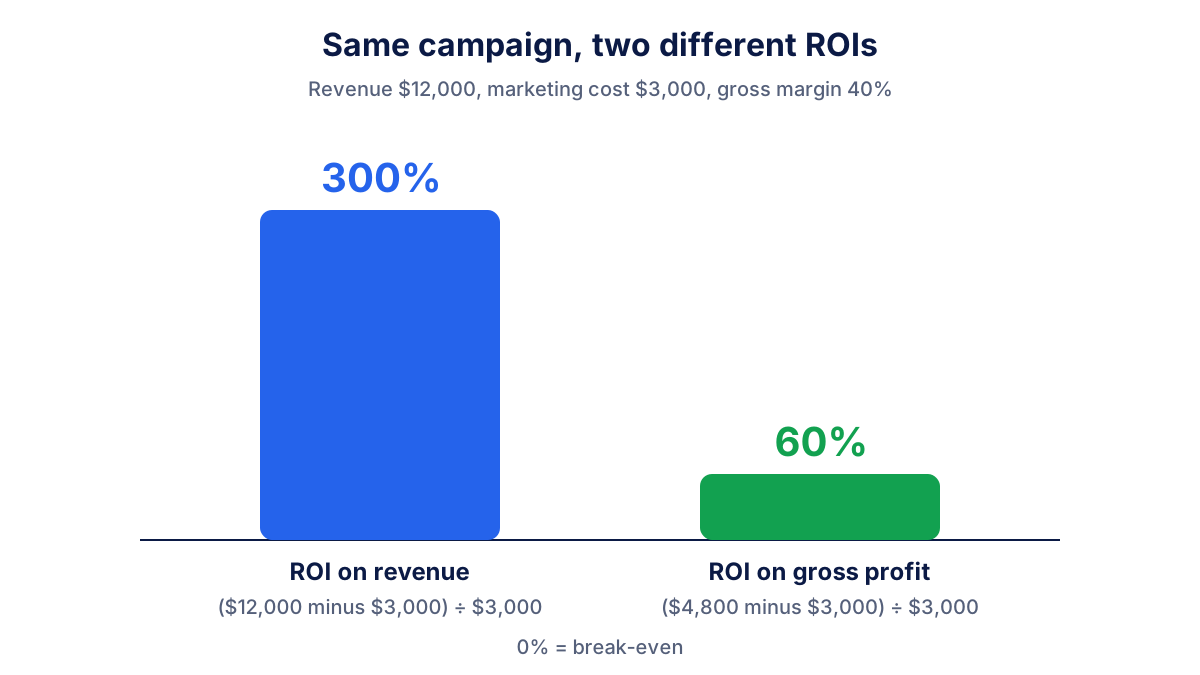
ROI on revenue uses sales as the gain. With the numbers above it is ($12,000 minus $3,000) ÷ $3,000 × 100 = 300%. It is the figure you will see in many presentations, because it is easy to calculate and looks great.
The problem: those $12,000 are not yours to keep. Part of the money pays for the products, the materials or the hours of work you sold. ROI on revenue treats all of it as gain.
ROI on gross profit uses only what is left after the cost of goods: 60% in the same example. Same campaign, same month, a number five times smaller. That smaller number is the honest one, because it answers the question a business owner actually asks: did the marketing earn more than it cost?
If you do not know your exact margin, use an average from your accounts. A rough margin is still far closer to reality than none. Service businesses without a cost of goods can use the share of revenue left after the direct cost of delivering the work.
Marketing ROI by channel: worked examples
Here is one hypothetical month for a business that advertises on four platforms, with a 40% gross margin on everything it sells.
| Channel | Cost | Revenue | Gross profit (40%) | Gain | ROI on gross profit |
|---|---|---|---|---|---|
| Google Ads | $2,000 | $8,000 | $3,200 | $1,200 | 60% |
| Meta Ads | $1,500 | $4,500 | $1,800 | $300 | 20% |
| Microsoft Ads | $500 | $2,500 | $1,000 | $500 | 100% |
| LinkedIn Ads | $1,000 | $2,000 | $800 | -$200 | -20% |
| Total | $5,000 | $17,000 | $6,800 | $1,800 | 36% |
A few things stand out. Microsoft Ads has the highest ROI on the smallest budget, which often means there is room to spend a little more there before returns fall. Meta Ads is positive but thin. LinkedIn is negative this month.
A negative month on LinkedIn does not automatically mean "switch it off". B2B deals often close weeks after the first click, so part of the revenue may land next month. This is where a longer window and the customer lifetime value help: a customer who stays for three years is worth more than the first invoice.
The total line matters as much as the rows. A 36% ROI across all channels says your marketing as a whole is paying for itself, even if one channel is not.
ROI vs ROAS: what is the difference?
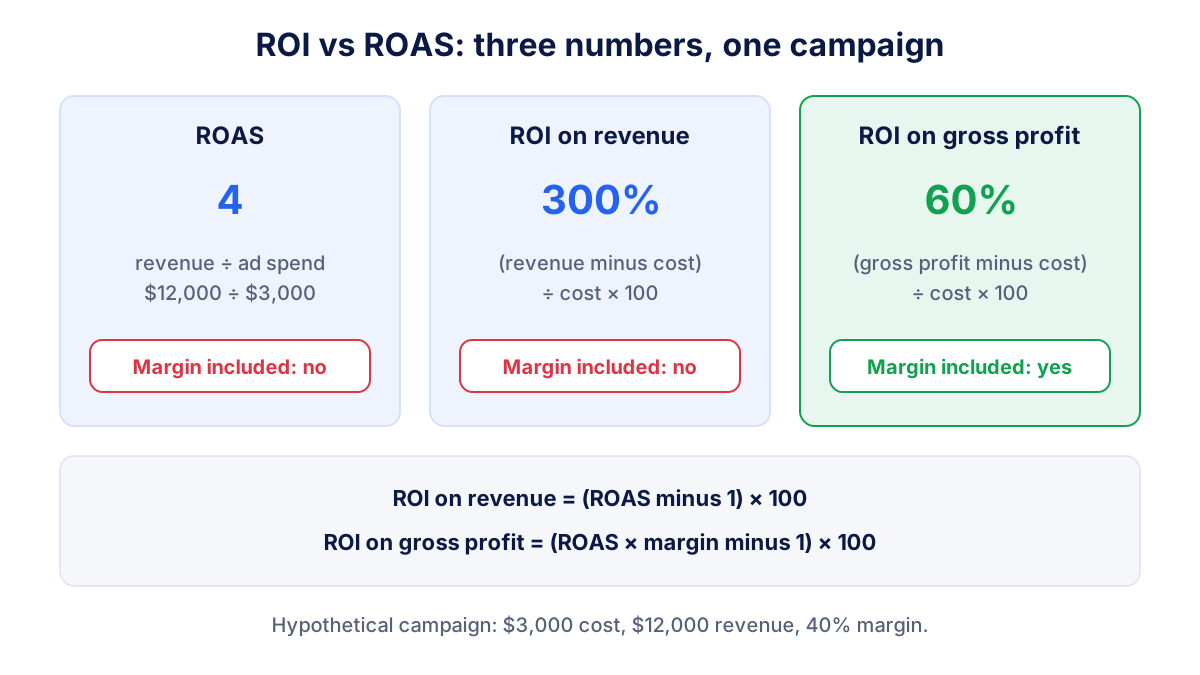
ROAS (return on ad spend) divides revenue by ad spend. ROI subtracts the cost first and, in its honest form, uses gross profit. Both come from the same data, but they answer different questions. The ROAS guide covers that metric in depth; here is how the two connect.
| ROAS | ROI on revenue | ROI on gross profit | |
|---|---|---|---|
| Formula | revenue ÷ ad spend | (revenue minus cost) ÷ cost × 100 | (gross profit minus cost) ÷ cost × 100 |
| Our example | $12,000 ÷ $3,000 = 4 | 300% | 60% |
| Includes your margin | no | no | yes |
| Best for | steering campaigns day to day | quick comparisons | deciding if marketing earns money |
You can convert one into the other. ROI on revenue = (ROAS minus 1) × 100. ROI on gross profit = (ROAS × margin minus 1) × 100. With a ROAS of 4 and a 40% margin: (4 × 0.40 minus 1) × 100 = 60%.
Break-even: when does marketing pay for itself?
Your break-even point is where ROI on gross profit is exactly 0%: the gross profit from the campaign covers its cost and nothing more.
Break-even revenue = marketing cost ÷ gross margin
With $3,000 of cost and a 40% margin, break-even revenue is $3,000 ÷ 0.40 = $7,500. Below $7,500 of sales the campaign loses money, above it the campaign earns. In ROAS terms that is a break-even ROAS of 2.5.
Notice what ROI on revenue says at that same point: ($7,500 minus $3,000) ÷ $3,000 × 100 = 150%. A campaign that only just covers its cost would look like a big success. This is the clearest reason to calculate ROI on gross profit.
Break-even is also useful before you spend. If you plan $3,000 for a campaign, ask whether $7,500 of sales is realistic given your traffic, conversion rate and average order. If it is not, change the budget or the offer before launch.
Why attribution makes marketing ROI uncertain
The cost side of ROI is precise: the platforms charge you an exact amount. The gain side depends on attribution, the rules that decide which campaign gets credit for a sale.
- Each platform counts in its own way. Google Ads uses a data-driven model by default for most conversion actions, with last click as the alternative (About attribution models). Meta Ads counts conversions within its own click and view windows. The same sale can appear in both.
- Some sales are invisible. A customer who clicks an ad on the phone and buys by phone call or in the shop a week later rarely shows up in the ad platform.
- Some sales would have happened anyway. Campaigns on your own brand name often capture people who were already looking for you, which inflates their ROI.
- Tracking gaps. Consent banners, ad blockers and broken tags remove conversions, which pushes ROI down.
So read marketing ROI as an estimate, not an exact figure. Two habits make it more reliable. Check the total: compare all the revenue the platforms claim with the sales you actually recorded. And keep attribution settings unchanged when you compare months, otherwise the ROI moves for reasons that have nothing to do with your marketing.
How often to measure marketing ROI
For most businesses, once a month is the right rhythm. A month has enough sales for the numbers to be stable, and it matches how invoices, budgets and accounts are organized.
- Monthly: ROI on gross profit per channel and in total, next to the previous month.
- Every quarter: a rolling three month ROI for channels with long sales cycles (LinkedIn, SEO, content), plus a check of your margin.
- Once a year: ROI per channel over twelve months, to decide where next year's budget goes.
Weekly ROI is mostly noise for a small business: one big order can swing it by dozens of points. Keep weekly checks for spend, clicks and leads, and leave ROI for the monthly review, together with your customer acquisition cost.
Klyrax puts the costs and results of Google Ads, Meta Ads, Microsoft Ads and LinkedIn in one summary, so you do not have to open four platforms to fill in the table above. On the 1st of each month a written report explains in plain language what changed compared with the previous month and up to three things to do next.
Common mistakes when calculating ROI
- Using revenue as the gain. It turns a modest result into an impressive one. Use gross profit whenever you can.
- Counting only ad spend. Agency fees, tools and creative work are marketing costs too. Leaving them out inflates ROI.
- Adding up platform figures. Google Ads and Meta Ads can both claim the same sale. The sum of their ROI is often higher than your real sales allow.
- Judging long cycles on one month. A B2B campaign or an SEO project needs a longer window.
- Mixing periods. Revenue from one month against cost from another produces a number that means nothing.
- Ignoring repeat customers. If customers buy again, the first sale understates what the campaign is worth.
- Changing definitions. Include tax one month and exclude it the next, and the trend becomes useless.
Calculate your break-even once, measure ROI on gross profit every month and read it as a range, not a single exact number. That is enough to know which channels earn money and where the next dollar should go.
Frequently asked questions
What is the formula for ROI?
ROI = (gain minus cost) ÷ cost × 100. If a campaign costs $3,000 and brings $4,800 of gross profit, ROI is ($4,800 minus $3,000) ÷ $3,000 × 100 = 60%. In marketing, use gross profit as the gain whenever you know your margin. Using revenue gives a much bigger number that ignores the cost of the products or services you sold.
What is a good marketing ROI?
Any ROI above 0% calculated on gross profit means the campaign paid for itself and left something over. Beyond that, there is no universal target: it depends on your margins, your fixed costs and how long customers stay. A ROI that looks low on the first sale can be fine if customers buy again for years. Compare each channel with its own previous months first.
What is the difference between ROI and ROAS?
ROAS divides revenue by ad spend and ignores every other cost. ROI subtracts the cost from the gain and divides by the cost, ideally using gross profit. A ROAS of 4 equals an ROI of 300% on revenue, but only 60% on gross profit with a 40% margin. ROAS is handy for steering campaigns, ROI tells you whether they earned money.
Can ROI be negative?
Yes. A negative ROI means the campaign brought back less than it cost. With $1,000 of spend and $800 of gross profit, ROI is ($800 minus $1,000) ÷ $1,000 × 100 = minus 20%. A negative month is not always a reason to stop: in B2B or for products bought again over time, the gain may arrive after the period you measured.
How often should I measure marketing ROI?
Once a month is right for most businesses: it gives enough sales to be stable and is short enough to react. For channels with long sales cycles, such as LinkedIn campaigns for B2B services or SEO, also look at a rolling three or six month ROI, because the revenue comes in weeks or months after the cost.
See how your marketing is really doing
Klyrax connects GA4, Search Console, Google Ads, Meta Ads, your Google reviews and more in read-only mode, shows the numbers that matter for your business and writes you a plain-language report every month.
Request info