
Impressions are the number of times your content, ad or search result was shown on a screen. They count displays, not people and not attention. So what are impressions good for? They tell you how visible you are, and they are the starting number for two metrics every business owner meets sooner or later: CPM and CTR.
This guide explains the impressions meaning in plain words, how Google Search Console, Google Ads, Meta, LinkedIn and email count them, the difference between impressions, reach, views and clicks, and why impressions can grow while clicks fall.
What are impressions?
An impression is one display of your content on someone's screen. Every time your Google result appears on a results page, your ad loads in a feed or your post shows up on LinkedIn, the platform adds one impression.
Three things follow from that definition:
- Impressions are not people. If one person sees your ad five times, that is five impressions.
- Impressions are not attention. A result at the bottom of a page can count even if nobody scrolls to it.
- Impressions come first. No one can click, call or buy before seeing you, so impressions sit at the top of every funnel.
In the reports we read with business owners, impressions are often the biggest number on the page. That makes them reassuring and easy to misread. The rest of this article is about reading them correctly.
How do Search Console, Google Ads, Meta, LinkedIn and email count impressions?
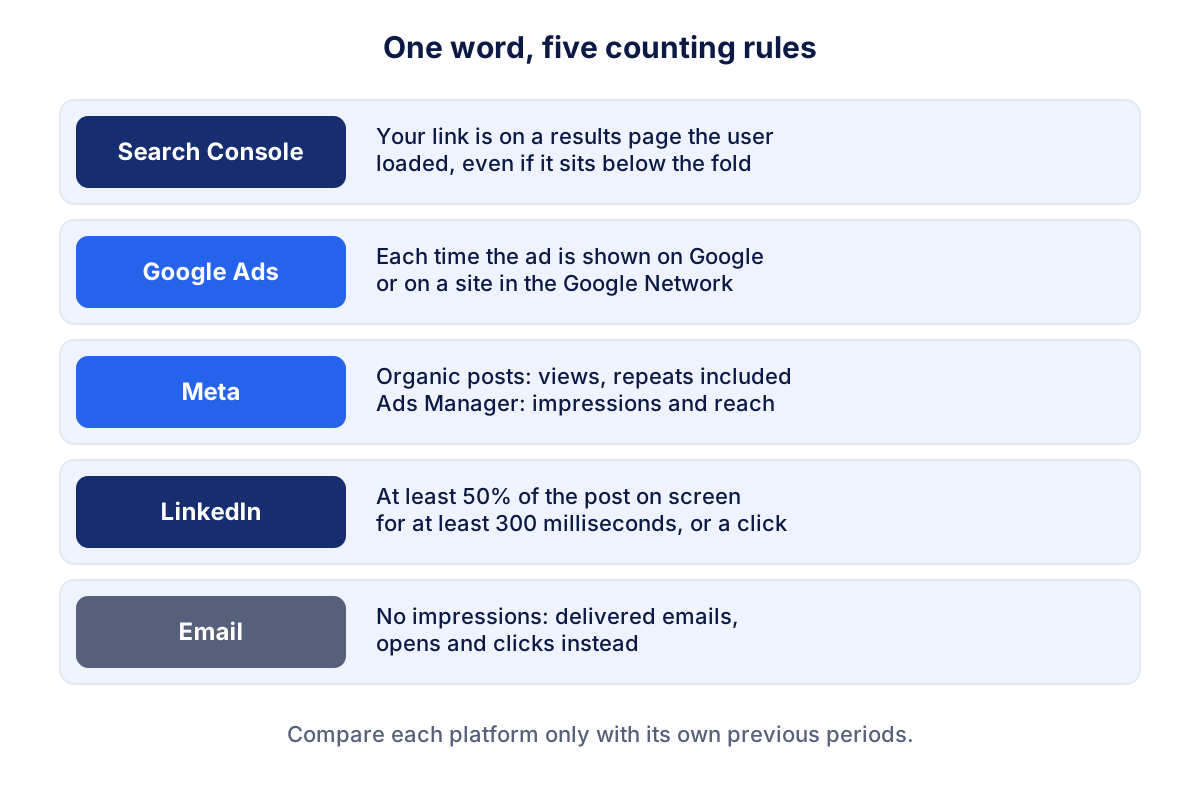
Every platform uses the word, but each one sets its own rule for when a display counts. This is the main reason you cannot add impressions from different tools into one total.
| Platform | When an impression is counted | Watch out for |
|---|---|---|
| Google Search Console | A link to your site is on a results page the user loaded, even below the fold | Carousels and infinite scroll need the item scrolled into view |
| Google Ads | Each time your ad is shown on Google or a site in the Google Network | Viewable impressions are a separate, stricter count |
| Meta (Facebook, Instagram) | Organic posts: views, every time content appears on screen. Ads: impressions on screen | Since 2025 organic insights show views instead of impressions |
| LinkedIn Page | Post at least 50% on screen for at least 300 milliseconds, or clicked | Includes impressions on reposts of your post |
| No impressions: tools report delivered emails, opens and clicks | Opens are inflated by privacy features in some mail apps |
A few details worth knowing:
- Search Console. According to Google's definition, an impression means a user has seen, or potentially seen, a link to your site in Search, Discover or News. Links inside an AI Overview follow the same impression rules and all share one position. Our Google Search Console guide covers the Performance report in detail.
- Google Ads. The Google Ads help center counts an impression each time your ad is shown. For display and video, Google Ads also reports viewable impressions, which only count ads that had a real chance to be seen.
- Meta. Meta introduced views as its main content metric: for photos, text posts and stories it replaced impressions, and repeat views by the same person count. Instagram and Facebook Page insights switched during 2025. In Ads Manager you still find impressions and reach as delivery columns. The Instagram Insights guide lists the current metric names.
- LinkedIn. The LinkedIn Page analytics help uses the 50% and 300 milliseconds rule, so a fast scroll past your post may not count.
- Email. Newsletters have no impressions. The closest number is the open rate, explained in our guide to email open rate.
Impressions vs reach vs views vs clicks
These four numbers describe different moments: being shown, being shown to a person, being watched and being acted on.
| Metric | What it counts | Can it count the same person twice? | Typical question it answers |
|---|---|---|---|
| Impressions | Displays on screen | Yes | How often were we shown? |
| Reach | Unique people or accounts who saw it at least once | No | How many people did we get in front of? |
| Views | Plays of a video, or (on Meta) displays of any content | Yes | How often was the content watched or seen? |
| Clicks | Clicks on the result, ad or link | Yes | How many people took the next step? |
Reach vs impressions
Reach vs impressions is the comparison people search most, and the answer fits in one line: reach counts people, impressions count displays. The link between the two is frequency.
Frequency = impressions ÷ reach
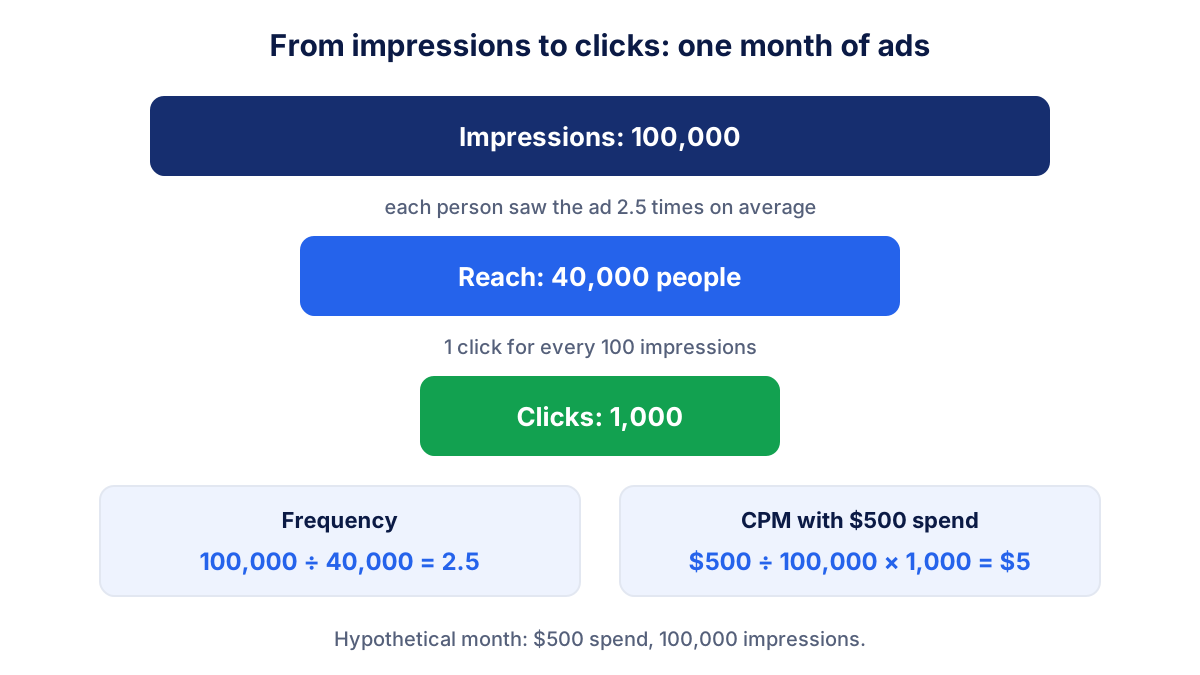
Take a hypothetical month of ads: 100,000 impressions, a reach of 40,000 people and 1,000 clicks. Frequency is 100,000 ÷ 40,000 = 2.5, so each person saw the ad two and a half times on average. A frequency that keeps climbing on a small audience is often the first sign that people are getting tired of the same ad.
Impressions vs views
Impressions vs views depends on the platform. On YouTube, an impression is counted when your thumbnail is shown, and a view only when someone actually watches. On Facebook and Instagram, "views" now covers both video plays and displays of photos, text posts and stories, so for those formats views work like the old impressions with repeats included. If your Meta numbers jumped in 2025 without any change in your content, the switch to views may explain it.
How impressions feed CPM and CTR
Impressions are the denominator of two common ratios. When impressions change, both ratios move even if nothing else does.
CPM = cost ÷ impressions × 1,000
CTR = clicks ÷ impressions × 100
With the same hypothetical campaign, $500 of spend over 100,000 impressions gives a CPM of $5, and 1,000 clicks give a CTR of 1%. If the next month brings 150,000 impressions for the same $500 and the same 1,000 clicks, CPM falls to about $3.33 and CTR to about 0.67%. Cheaper visibility, weaker attraction. Whether that is a good trade depends on what happens after the click.
The full formulas, a calculator and benchmarks are in our guides to CPM and CTR.
Why can impressions rise while clicks fall?
Impressions going up while clicks go down is a pattern many sites see in Search Console, and it is not always bad news.
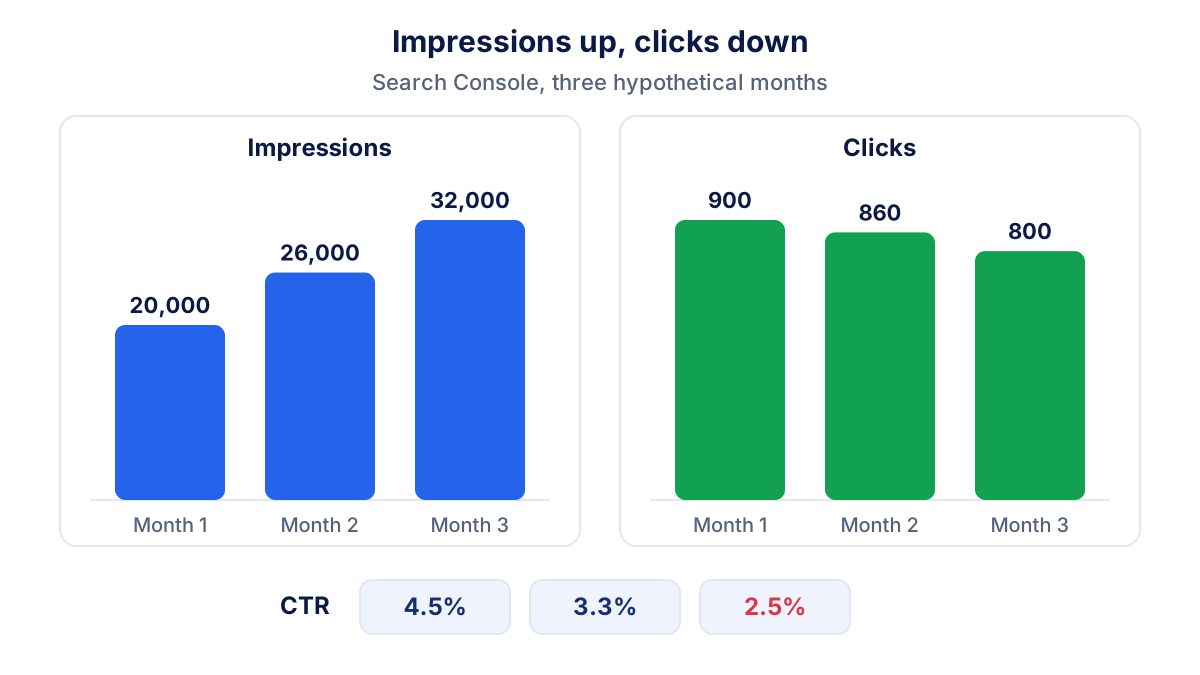
The usual causes:
- AI Overviews. A link to your page inside an AI Overview counts as an impression. If the answer satisfies the user, there is no click. Our article on Google AI Mode and AI Overviews looks at what this changes for your site.
- New queries at low positions. When your site starts appearing for many new searches on page one's lower half or on page two, impressions jump and clicks barely move.
- Position changes. Dropping from third to sixth place on your main query can cut its clicks sharply while impressions stay flat.
- More searches overall. Seasonal demand or news can raise impressions for queries where people rarely click.
- Broader ad targeting. In paid campaigns, a wider audience adds impressions from people less likely to click.
To find the cause, open Search Console, compare the last 28 days with the previous period and sort queries by the change in impressions. Then check, for the top movers, whether position moved and whether clicks followed. If Search Console and GA4 disagree on traffic, read that article before drawing conclusions.
Are impressions a useful KPI for a business?
Impressions are a useful KPI when visibility is the goal: a new website building search presence, a brand awareness campaign, a new market. In those cases a steady rise in impressions is real progress, even before clicks follow.
Impressions are a weak KPI when you need leads or sales. A campaign can buy a million cheap impressions and produce nothing. For those goals, keep impressions as context and judge the result on clicks, conversions and cost per result. Engagement metrics sit in between; our guide to engagement rate explains when to divide by impressions and when by reach.
What to check every month
A short monthly routine that works for most businesses:
- Search impressions and clicks, compared with the previous month and with the same month last year.
- Queries with many impressions and few clicks. Their titles and descriptions are the first thing to improve.
- Ad impressions, reach and frequency for each campaign. Rising frequency on a flat reach means the same people see you again and again.
- CPM and CTR together. A lower CPM with a much lower CTR is rarely a saving.
- Social views and reach, compared only with your own previous months on the same platform.
Klyrax puts impressions, clicks and CTR from Search Console, Google Ads, Meta Ads and LinkedIn in one place, each compared with the previous period, and on the 1st of each month a written report explains in plain language what changed.
Common misreadings of impressions
- Adding impressions across platforms. A LinkedIn impression and a Search Console impression follow different rules. A combined total looks impressive and means little.
- Reading impressions as people. 100,000 impressions may be 40,000 people or 10,000. Look at reach.
- Comparing Meta numbers across the 2025 switch. Views count repeats on formats where impressions used to be the reference, so a jump can be a change of definition.
- Celebrating impressions without clicks. More visibility on queries nobody clicks on is not more business.
- Panicking about a falling CTR. If impressions grew a lot, CTR falls by arithmetic. Check whether clicks actually dropped.
Frequently asked questions
What are impressions in simple terms?
Impressions are the number of times something you published was displayed on a screen: a search result, an ad, a post. They do not tell you whether anyone looked at it closely, clicked or bought. If your ad was shown 10,000 times to 4,000 people, it has 10,000 impressions and a reach of 4,000. Impressions measure visibility, the first step before any click.
What is the difference between reach and impressions?
Reach counts the people (or accounts) who saw your content at least once. Impressions count every display, including repeats to the same person. Impressions are always equal to or higher than reach. Dividing impressions by reach gives frequency: 10,000 impressions and 4,000 people reached mean each person saw the content 2.5 times on average.
What are impressions on LinkedIn?
On a LinkedIn Page, an impression is counted when a post is at least 50% visible on a signed-in member's screen for at least 300 milliseconds, or when it is clicked. Unique impressions count distinct members instead. Since 2024, post impressions also include impressions on reposts of your content by other members, so a share can raise your numbers.
What are impressions in Google Search Console?
In Google Search Console, an impression means a link to your site appeared on a results page that a user loaded in Search, Discover or News. The user does not need to scroll down to your result for it to count, except inside carousels and infinite scroll. A link inside an AI Overview counts as an impression too, with the same rules.
Are impressions and views the same thing?
Not always. On Facebook and Instagram, Meta replaced impressions with views for organic content during 2025: a view is counted each time a post or story appears on screen or a video starts playing, repeats included. On YouTube and other video platforms, a view usually needs someone to watch, while an impression only needs the thumbnail to be shown.
See how your marketing is really doing
Klyrax connects GA4, Search Console, Google Ads, Meta Ads, your Google reviews and more in read-only mode, shows the numbers that matter for your business and writes you a plain-language report every month.
Request info