AI visibility is how often ChatGPT and other AI assistants mention your business when people ask them about your field. More and more customers ask an assistant "which accountant in Denver works with small businesses?" instead of typing a short query into Google. If your name is not in the answer, you are not on the shortlist, and no report from your website will tell you.
This guide shows how AI assistants choose the businesses and pages they cite, a simple monthly test you can run yourself, what increases the chance of being mentioned and how to turn the results into one number you can follow over time.
What is AI visibility?
AI visibility is the share of AI answers about your topic that name your business or link to your website. It works like search visibility, but the "results page" is a written answer from ChatGPT, Gemini, Perplexity, Claude, Copilot or Google's AI Overviews.
Two things count, and they are different:
- Mention: the assistant names your business in its answer ("Smith & Co is an accounting firm in Denver that…").
- Citation: the assistant links to one of your pages as a source for what it says.
A mention builds awareness. A citation can also bring a visit. A business can be mentioned without being cited, for example when the assistant learned the name from other websites, and cited without being recommended, for example when it quotes your price page while recommending a competitor.
If you want the wider context of how this changes search work, the guide on GEO vs SEO explains what generative engine optimization adds to classic SEO.
How do ChatGPT and other AI assistants choose their sources?
Nobody outside the AI companies knows the exact rules, and they change often. What the providers do document is enough to understand the two ways an answer is built.
Answers from what the model learned
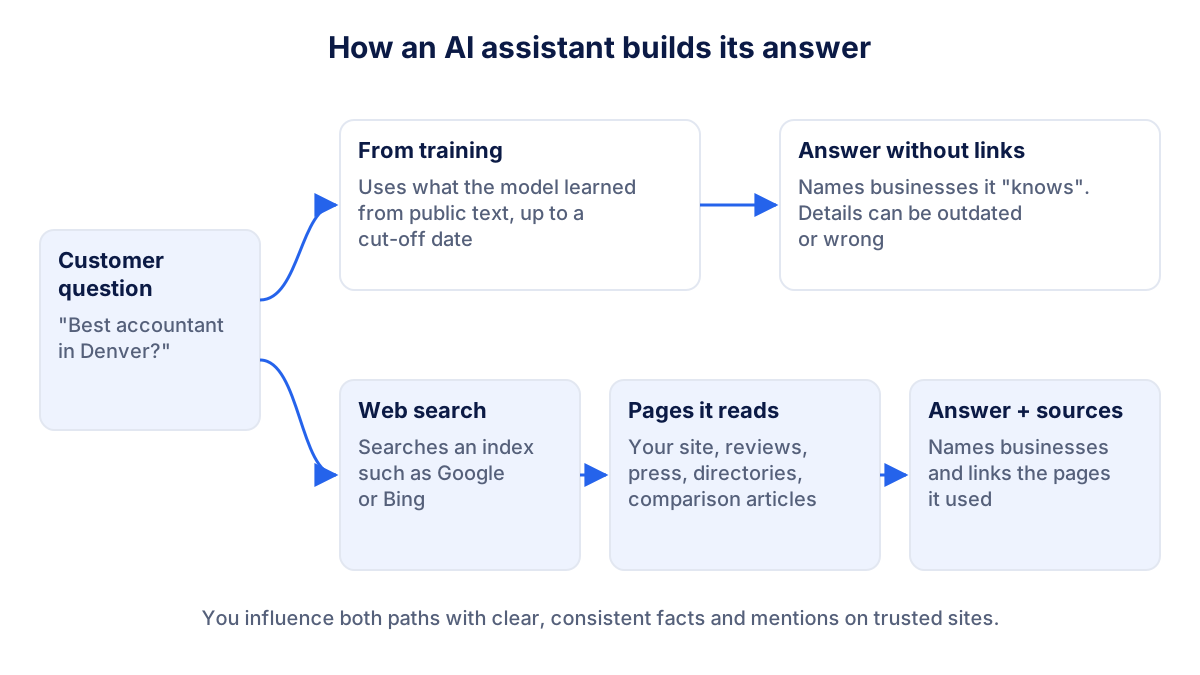
Without a web search, the assistant answers from what its model learned during training, from a very large amount of public text. If your business was described often and consistently on the web, the model may "know" it. If not, it may ignore you or, worse, mix up details. This knowledge has a cut-off date, so recent changes such as a new address or a new service may be missing.
Answers based on a web search
When the question needs current or local information, assistants like ChatGPT, Perplexity, Gemini and Copilot can search the web first, read a handful of pages and write the answer from them, usually with links to the sources. Here your normal search presence matters a lot: a page that cannot be found by search engines cannot be read by the assistant either.
What the main providers say officially:
| Assistant | How it gets current information | What you can check |
|---|---|---|
| ChatGPT | Searches the web when needed and shows sources | Allow OAI-SearchBot in robots.txt, as OpenAI's crawler documentation recommends |
| Google AI Overviews and AI Mode | Use Google Search's index | Page indexed and eligible for a snippet, per Google's guide to AI features |
| Perplexity | Searches the web for each question and adds footnotes to sources | Pages crawlable and clearly written |
| Copilot | Built on Bing search | Site verified in Bing Webmaster Tools |
Google is explicit that there are no special optimizations or extra files needed to appear in AI Overviews or AI Mode: the normal SEO basics apply. Traffic from those features is included in the Search Console Performance report under the "Web" search type. For Copilot and other tools that use Bing, the Bing Webmaster Tools guide shows how to check that Bing indexes your site.
How to check if ChatGPT mentions your business: a monthly test
You do not need a tool to start. You need a fixed list of questions and the discipline to ask them the same way every month.
- Write 10 to 20 prompts your customers would ask. Mix four types: category ("best accountant in Denver for small businesses"), problem ("how do I pay quarterly estimated taxes as a freelancer?"), comparison ("Smith & Co or Jones Accounting?") and brand ("what do you know about Smith & Co, Denver?").
- Use the same assistants each time. ChatGPT, Gemini, Perplexity and Claude cover most uses; add Copilot if your customers work in Microsoft tools.
- Use a clean session. Log out or open a temporary chat so past conversations do not shape the answer. Note the date and, for local questions, the city you are in.
- Record three facts per answer: mentioned (yes or no), cited with a link (yes or no) and which competitors appear.
- Check the brand answer for errors. Wrong opening hours, an old address or a service you no longer offer tell you which facts to fix on your site and profiles.
- Repeat monthly with the same list. Change the list only when your offer changes, otherwise you cannot compare months.
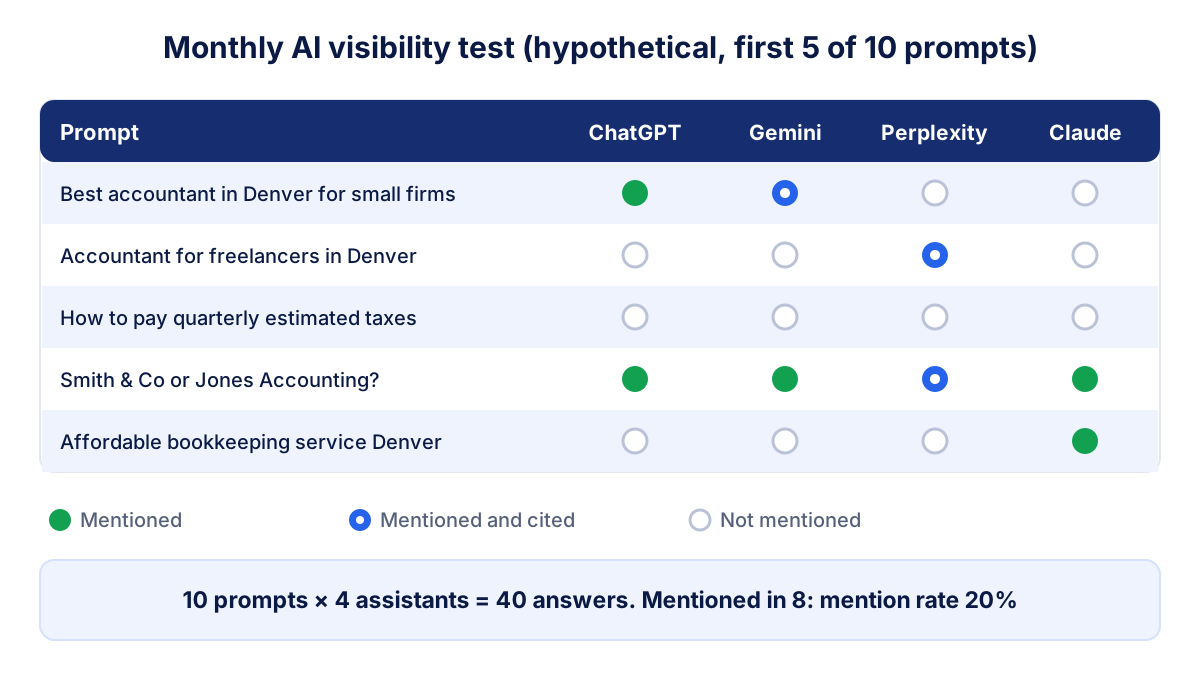
Expect noise. The same prompt can give different answers an hour apart, so a single run proves little. Ten prompts on four assistants already give you 40 answers per month, which is enough to see a direction.
How to rank in ChatGPT: what increases the chance of being cited
There is no position one in ChatGPT and no way to buy a mention in the organic answer. What you can do is make your business easy to find, easy to understand and confirmed by others.
Clear facts about your business
Have one page, usually "About", that states plainly who you are, what you do, where and for whom. One sentence per fact: "Smith & Co is an accounting firm in Denver serving small businesses and freelancers since 2009." Assistants extract and repeat sentences like this. Add structured data (Organization or LocalBusiness markup) if your site supports it, keeping it consistent with the visible text.
The same facts everywhere
Name, address, phone, services and opening hours should be identical on your website, your Google Business Profile, directories and social profiles. Contradictions are a common source of wrong answers about a business.
Mentions on trusted third-party sites
Assistants often name the businesses that other sources name: local press, trade associations, comparison articles, review platforms. A mention in a respected industry article can matter more than another page on your own site. Google reviews also help, because they appear on the profile that assistants with web search can read.
Pages that answer questions directly
Pages with an answer in the first lines, clear headings phrased as questions, short paragraphs and tables are easier to quote. A pricing page that says "a monthly bookkeeping package starts at $150" can be cited. A page that says "contact us for a quote" cannot.
Let the crawlers in
Check your robots.txt file. OpenAI explains that sites that block OAI-SearchBot will not be shown in ChatGPT search answers, and that this crawler is separate from GPTBot, which collects training data. You can allow one and block the other.
How to measure your share of voice in AI answers
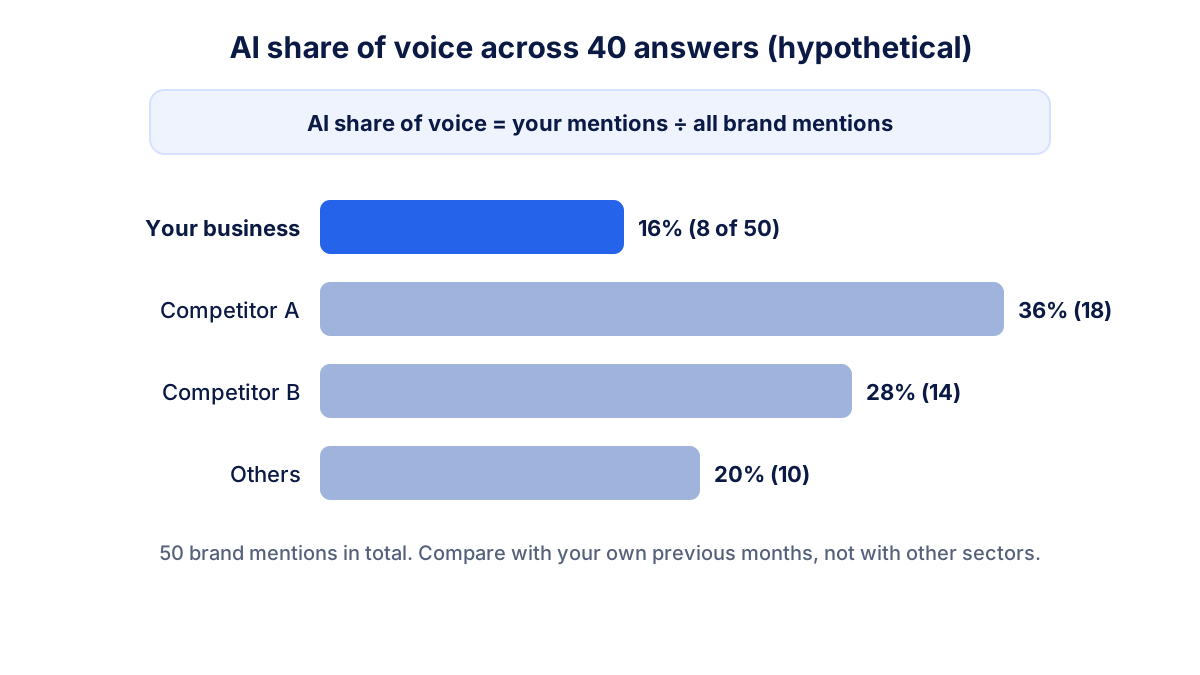
A count of mentions is a start. To compare yourself with competitors, use share of voice: your mentions as a percentage of all brand mentions in the answers you tested.
AI share of voice = your mentions ÷ mentions of all brands × 100
Take a hypothetical month: 10 prompts on 4 assistants give 40 answers. Your business appears in 8 of them, so your mention rate is 20%. Across the same 40 answers, brands are mentioned 50 times in total: you 8, competitor A 18, competitor B 14, others 10. Your AI share of voice is 8 ÷ 50 = 16%, competitor A has 36%.
| Metric | Formula | Hypothetical value |
|---|---|---|
| Mention rate | answers that mention you ÷ answers tested | 8 ÷ 40 = 20% |
| Citation rate | answers that link to your site ÷ answers tested | 3 ÷ 40 = 7.5% |
| AI share of voice | your mentions ÷ all brand mentions | 8 ÷ 50 = 16% |
There is no reliable benchmark for these numbers yet. They depend on your sector, your city, how many competitors exist and which prompts you chose. Compare yourself with your own previous months and with the same competitors. The guide to share of voice explains the metric in more depth, including on social media and search.
Common mistakes with AI visibility
- Testing only your brand name. Almost every assistant will say something when asked about you by name. The real test is whether you appear when the customer does not know you yet.
- Judging from one screenshot. Answers vary. Look at a month of answers, then at the trend.
- Blocking every AI crawler by default. Some security plugins or hosting settings block them all. Decide crawler by crawler.
- Forgetting Bing. Several assistants rely on Bing's index. If Bing does not index your site, part of the AI world cannot see you.
- Paying for "guaranteed" ChatGPT rankings. Nobody controls what a model says. Be wary of anyone who promises it.
How to follow AI visibility every month
A spreadsheet works for 10 prompts. It becomes tedious with 30 prompts on five assistants, which is why dedicated tools now run the prompts for you and count mentions, citations and share of voice per platform.
Klyrax connects to psentry, one of these tools, to show your AI visibility in ChatGPT, Gemini, Perplexity and Claude next to your Search Console, GA4 and Google Ads data. On the 1st of each month it writes a plain-language report on what changed across your channels and up to three things to do next. Whether you use a tool or a spreadsheet, keep the prompt list fixed, look at the trend and fix the facts that assistants get wrong.
Frequently asked questions
How do I know if ChatGPT mentions my business?
Ask it the questions your customers would ask, not your brand name alone. Write 10 to 20 prompts such as best provider of your service in your city, run them on ChatGPT, Gemini, Perplexity and Claude, and note for each answer whether your business is named, linked as a source or missing. Repeat the same list every month to see the trend.
How do I rank in ChatGPT?
There is no fixed ranking in ChatGPT like the ten results on Google. You raise the chance of being mentioned by publishing clear facts about your business on your own site, keeping those facts identical everywhere, earning mentions on trusted third-party sites and allowing OpenAI's search crawler, OAI-SearchBot, in your robots.txt file.
Does SEO help with visibility in ChatGPT and AI Overviews?
Yes. Google states that pages shown as links in AI Overviews and AI Mode must be indexed and eligible to appear in Search with a snippet, with no extra technical requirements. Assistants that search the web also rely on search indexes. Good SEO is the foundation, and AI visibility adds a few habits on top.
Why does ChatGPT give a different answer every time?
AI assistants generate each answer fresh, so wording, sources and the businesses they name can change between two runs of the same prompt. Answers can also depend on the account, the location, the model version and whether the assistant searched the web. That is why you measure across many prompts and months, not from a single screenshot.
Can I stop ChatGPT from using my website?
You can, but think about what you block. OpenAI documents separate crawlers: OAI-SearchBot surfaces websites in ChatGPT search, while GPTBot collects content for training models. Each one is controlled separately in robots.txt, so you can allow OAI-SearchBot to stay visible in ChatGPT search and disallow GPTBot if you do not want your content used for training.
See how your marketing is really doing
Klyrax connects GA4, Search Console, Google Ads, Meta Ads, your Google reviews and more in read-only mode, shows the numbers that matter for your business and writes you a plain-language report every month.
Request info